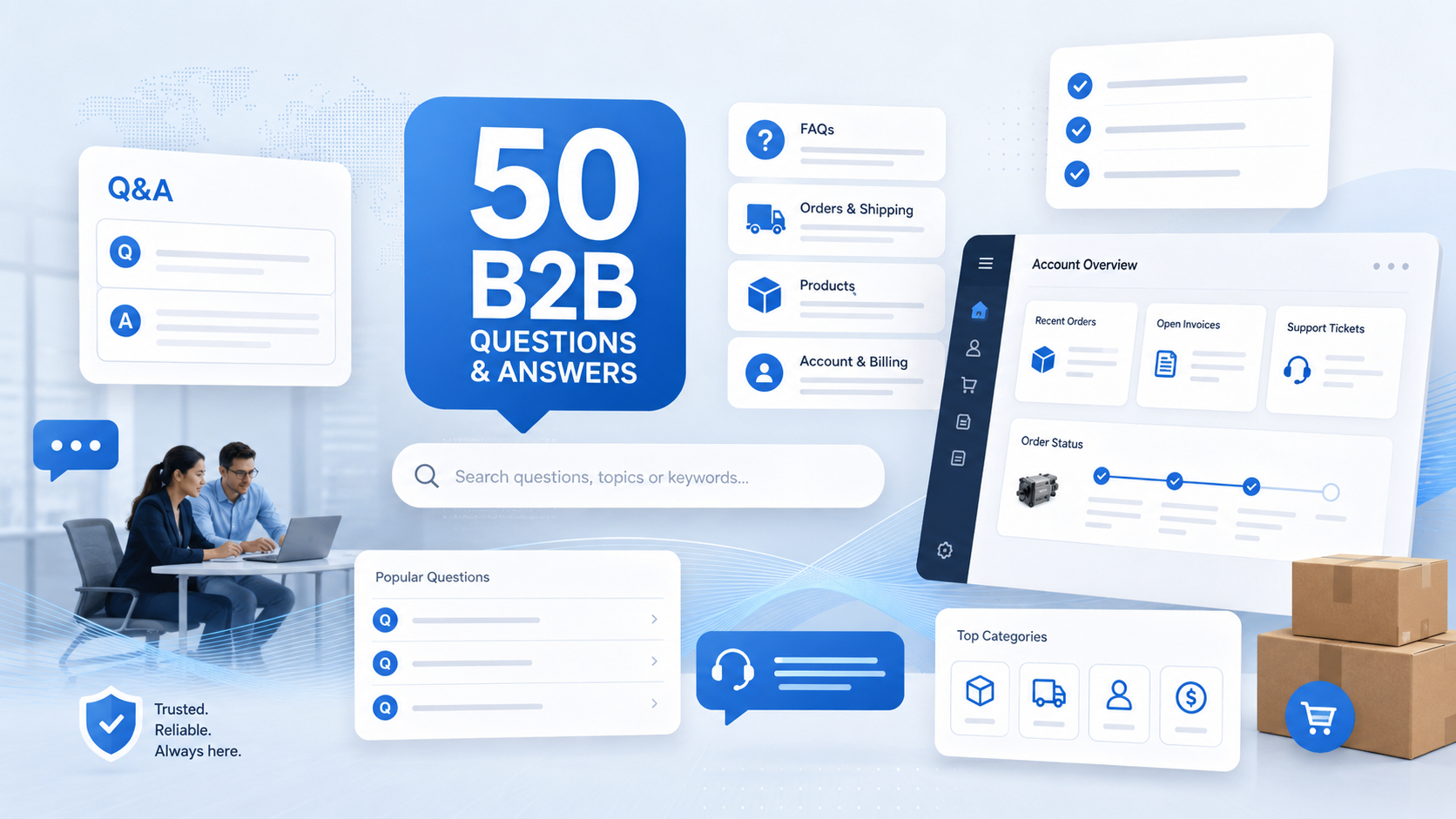
What is B2B ecommerce?
B2B ecommerce is the online sale of products or services from one business to another. That simple definition is useful, but it leaves out the reason B2B commerce projects become more complex than standard retail sites.
In B2B, the buyer is usually purchasing for a company, location, department, job, project, branch, franchise, dealer, or procurement team. The person placing the order may not be the person approving it. The price may depend on a contract. The product list may depend on account eligibility. Payment may happen by invoice instead of credit card. The order may need to flow into ERP, CRM, inventory, tax, fulfillment, and accounting systems before it is truly usable.
That is why B2B ecommerce is best understood as a digital buying system, not just an online store.
A basic definition
At its most basic level, B2B ecommerce lets one business research, configure, quote, purchase, reorder, or manage products and services online from another business. It can include a public catalog, a logged-in customer portal, a private ordering site, a dealer portal, a procurement integration, or a hybrid experience that blends self-service with sales support.
The goal is not always to replace the sales team. In many cases, the goal is to remove friction from repeat orders, account service, quote requests, invoice access, product discovery, and routine questions so sales and service teams can spend more time on higher-value work.
What makes B2B ecommerce different from a simple online catalog?
An online catalog shows products. B2B ecommerce helps a business buyer take action with confidence.
A useful B2B ecommerce experience often needs to answer questions like:
- Can this buyer see this product?
- Can this account buy this item at this price?
- Is the buyer ordering for the correct company location?
- Does the order require approval?
- Can the buyer use invoice terms, purchase order payment, ACH, or credit card?
- Does the product need a quote, configuration review, certificate, documentation, or compliance check?
- Will the order flow cleanly into ERP without manual cleanup?
Those questions are where many B2B projects succeed or struggle. The storefront may look simple, but the operational logic underneath needs to be clear.
Common B2B ecommerce capabilities
Most B2B commerce programs include some mix of these capabilities:
- Account-based pricing: Customers see prices based on contracts, negotiated rates, customer groups, dealer level, volume tiers, or ERP rules.
- Customer-specific catalogs: Different accounts may see different products, categories, availability, documentation, or purchase options.
- Company accounts and buyer roles: Multiple users can belong to the same business account, with different permissions for browsing, ordering, approving, paying invoices, or managing users.
- Quotes and assisted selling: Buyers can request quotes when pricing, volume, custom configuration, freight, or sales review is needed.
- Bulk ordering and quick order: Buyers can enter SKUs, upload order files, reorder from history, or use saved lists.
- Invoice and payment terms: Approved accounts may place orders using net terms, purchase orders, deposits, ACH, or invoice payment workflows.
- Approvals and purchasing controls: Some buyers can build carts while managers approve spend, locations, products, or budgets.
- ERP and CRM integration: Product data, pricing, inventory, order history, customer records, invoices, credit status, and fulfillment details often need to sync with back-office systems.
Why B2B ecommerce matters
B2B ecommerce matters because customers increasingly expect to solve routine buying tasks without waiting on email, phone calls, spreadsheets, or manual re-entry. A well-planned portal can reduce order-entry work, improve product and pricing accuracy, give customers better visibility, and make sales teams more effective.
But the value only appears when the ecommerce experience reflects how the business actually sells. If pricing is wrong, roles are unclear, product data is thin, approvals are missing, or ERP handoff is fragile, the site becomes another manual workaround.
What companies should define before starting
Before selecting technology or designing screens, define the buying rules:
- Who buys, approves, and pays?
- Which accounts get which products and prices?
- Which workflows require quotes or sales review?
- Which data must come from ERP, CRM, PIM, inventory, or accounting?
- Which orders can be fully self-service and which should be assisted?
- What will make the first launch valuable without trying to automate everything at once?
This is where Collin Commerce can help. The work is not only platform setup. It is translating messy commercial operations into a digital buying experience that customers can use and internal teams can trust.
FAQ
Is B2B ecommerce only for large companies?
No. Mid-market manufacturers, distributors, wholesalers, suppliers, and service businesses can benefit from B2B ecommerce when repeat ordering, account pricing, product discovery, and customer service volume create friction.
Does B2B ecommerce replace ERP?
No. ERP usually remains the system of record for customers, pricing, inventory, orders, invoices, and accounting. Ecommerce should work with ERP, not pretend it does not exist.
Can a B2B company also sell B2C online?
Yes. Some businesses run blended B2B and B2C models, but the account rules, pricing, checkout, tax, fulfillment, and customer experience need to be designed carefully so one model does not break the other.
Conclusion
B2B ecommerce is the digital version of business buying, but the best implementations go beyond transactions. They clarify account rules, expose the right information, reduce manual work, and help customers buy with confidence. The companies that succeed treat ecommerce as an operational system, not just a storefront.